


Automated review requests are messages triggered by a specific customer action, a completed purchase, a finished appointment, a resolved support ticket, sent out consistently without anyone on your team having to remember to ask.
The time saved is real, but it’s actually the smaller benefit. The bigger one is what consistency does to your review volume over time, since a request that goes out every single time beats one that only goes out when a staff member happens to think of it.
Here’s exactly how the hours add up, why automation multiplies feedback rather than just collecting it faster, and what separates a genuinely good system from one that just spams people.
Where the Hours Actually Go
Picture asking every customer manually. That’s remembering to ask at the right moment, finding the right words each time, sending the message or handing over a link, and doing it again for the next customer, and the one after that.
On a slow day, that’s manageable. On a busy day, it’s the first thing that gets skipped, because nobody stops mid-shift to fire off review requests when there’s an actual line of customers waiting.
Multiply that across a week, a month, a year, and the actual cost isn’t just the minutes per request. It’s the requests that never went out at all because someone was busy, distracted, or it simply slipped their mind. That’s not a training problem. It’s what happens when a task depends entirely on a human remembering it in the middle of everything else their job actually requires.
Automation removes the “remembering” part entirely. The trigger fires the moment the qualifying action happens, every time, whether your team is slammed or slow.
Why Automation Multiplies Feedback
This is the part that’s easy to underestimate. It’s not just that automated requests save time, it’s that consistency compounds in a way manual asking never does.
A business that asks 100 per cent of customers, every time, ends up with dramatically more total feedback than one that asks half the time when someone remembers to. And that steady flow has a second benefit beyond raw volume: platforms like Google generally favour a consistent trickle of new reviews over sporadic bursts.
A business getting two or three new reviews every week, reliably, tends to look more credible and active than one that gets ten in a single push and then goes quiet for two months. Automation is what actually makes that steady pace possible, because it doesn’t depend on anyone’s memory or mood on a given day.

What Separates Good Automation From Spam
Automating the ask doesn’t mean blasting every customer with a robotic message the second they walk out. The systems that actually work share a few things in common.
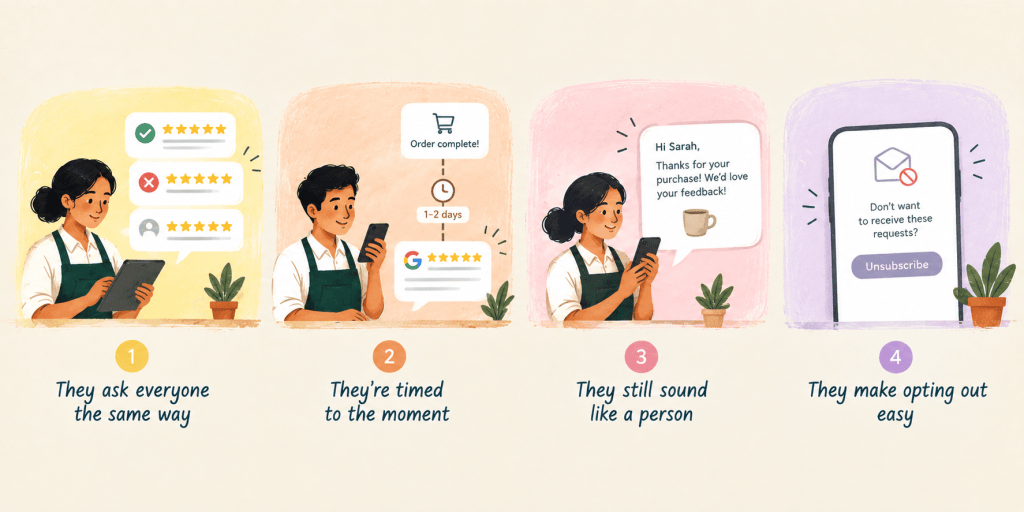
They ask everyone the same way:
Filtering who gets asked based on how the interaction went is called review gating, and it’s against most platform policies for good reason, it quietly skews your feedback toward only your best moments. Automation done right removes that temptation entirely, since the trigger fires regardless of how the visit or order went.
They’re timed to the moment:
A request sent the instant someone completes checkout feels premature. One sent a day or two later, once they’ve actually had the product or experience, lands better and gets more genuine responses.
They still sound like a person:
Using the customer’s name and referencing what they actually bought or booked makes a templated message feel considered rather than mass-produced, even though it technically is automated.
They make opting out easy:
A respectful automated system always includes a clear way to stop receiving requests. Beyond just being good practice, it protects your sending reputation and keeps the people who do respond genuinely willing to.
The Trigger Points That Actually Work
Most automated review systems key off a handful of natural moments: a completed purchase or delivery, a finished appointment or reservation, or a support ticket marked resolved. Each of these represents a point where the customer has actually experienced the thing you want feedback on, which is exactly why they work better than a generic scheduled blast unrelated to anything the customer just did.
Where Olly Fits Into This
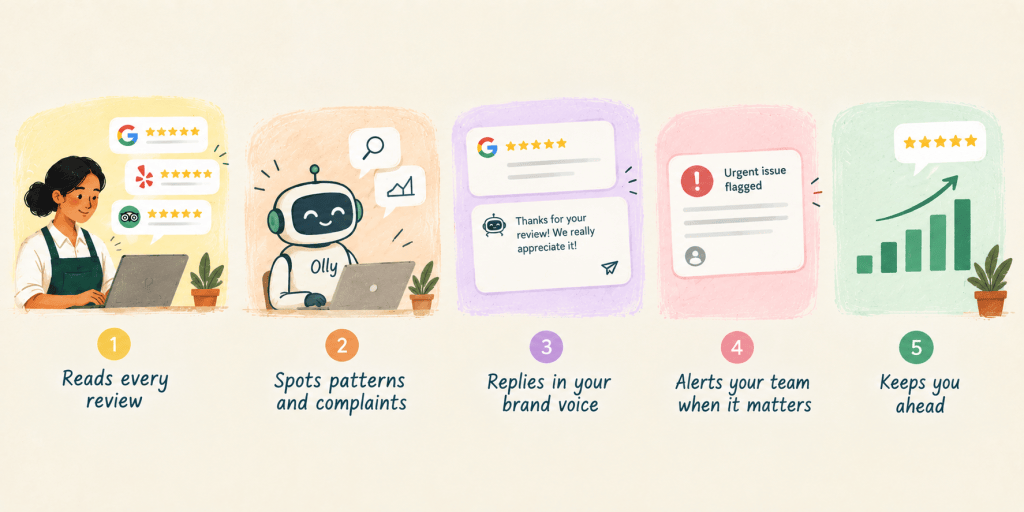
Once your review requests start working and the reviews begin arriving, Olly takes over from there. It reads every single one, across Google, Yelp, TripAdvisor, and a dozen other platforms, spots the patterns and recurring complaints a person would miss, replies in your brand voice, and alerts your team the moment something serious needs attention.
That’s the real payoff of automating the ask in the first place: more reviews only helps if someone is actually keeping up with all of them.
Set up your review request automation to bring in the volume, and let Olly handle everything that happens next, every review read, every pattern caught, every serious complaint flagged before it sits overnight. Automating the ask gets you more reviews. Olly is what keeps you ahead of all of them.
Frequently Asked Questions
Ques. What counts as an automated review request?
Ans. A message triggered by a specific customer action, like a completed purchase or finished appointment, sent out consistently without a staff member manually initiating it each time.
Ques. Does automating review requests actually get more reviews than asking manually?
Ans. Generally yes, because consistency matters more than any single well-worded ask. A system that asks every customer, every time, reliably out-produces manual asking, which tends to lapse whenever staff get busy.
Ques. Is it against the rules to automate review requests?
Ans. No. Automating the ask itself is fine. What’s restricted is filtering who gets asked based on how happy they seemed, offering incentives tied to leaving a review, or requesting reviews while the customer is still on-premises.
Ques. What’s the ideal timing for an automated review request?
Ans. Usually a day or two after the purchase, delivery, or appointment, once the customer has actually experienced what you’re asking about, rather than the instant a transaction completes.
Ques. Can automated requests feel impersonal?
Ans. They can, if the message is generic and unpersonalized. Using the customer’s name and referencing their specific order or visit keeps it feeling considered, even though the trigger behind it is automated.
The Actual Payoff
The time saved is nice. The real value is what happens when asking for feedback stops being a task someone has to remember and becomes something that simply happens every time, without exception. That consistency is what actually builds a review profile that looks active, credible, and current, month after month, instead of one that spikes occasionally and goes quiet in between.
Set the triggers up once, keep the message personal, and let the system handle the part that used to fall through the cracks on a busy day.