


Customer sentiment analysis is the practice of reading customer feedback, reviews, and messages to figure out the emotion behind the words, not just whether the rating was good or bad.
For a small business, it means finally understanding the difference between a customer who left three stars because they were mildly annoyed and one who left three stars because they were furious but too polite to say so. Star ratings tell you what happened. Sentiment tells you how the customer actually felt about it, and that gap matters more than most business owners realise.
Here’s what it actually is, why it matters more for a small business than a large one, and how to start using it without hiring an analytics team you don’t have the budget for.
What Sentiment Analysis Means
Strip away the buzzword, and sentiment analysis is a simple idea: software reads text and sorts it into positive, negative, or neutral, sometimes going a step further to flag specific emotions like frustration, confusion, or delight. It looks at word choice, tone, and context, not just keywords. “The food was fine” and “the food was amazing” both technically praise the food, but they carry very different energy, and a decent sentiment tool picks up on that difference.
Here’s where it gets genuinely useful for a small business. A customer might write, “Service was quick, I’ll give it that, but the staff seemed like they’d rather be anywhere else.” That’s a four-star review on the surface. Read the actual sentence, though, and you’re looking at a customer describing a genuinely bad experience with your team, one that a star count alone would never surface. Sentiment analysis exists to catch exactly that kind of gap between the number and the feeling.
Why This Matters for a Small Business
It’s easy to assume sentiment analysis is a luxury for companies with data teams and dashboards. It’s actually the opposite.
A large chain gets thousands of reviews a month, enough that a few misread ones barely move the average. A small business might get fifteen reviews in that same month, and every single one of them carries real weight in shaping how the next hundred customers see you.
When you don’t have the volume to average out the noise, you need to understand each piece of feedback properly, not just glance at the star and move on.
A small business owner reading every review personally can absolutely catch nuance, that’s a real advantage you have. But you’re also busy running the actual business, and nuance is exactly the thing that gets missed when you’re skimming reviews between shifts instead of sitting down and reading them properly. Sentiment analysis isn’t replacing your judgment.
It’s making sure nothing slips past it just because you didn’t have time to read closely.
What It Catches That Star Ratings Miss
A star rating is a single number standing in for an entire experience, and single numbers flatten a lot of detail. Here’s what tends to disappear in that flattening:

Mixed review: A customer who loved the product but hated the delivery time often lands on three stars, right in the middle, which tells you nothing about which part actually needs fixing.
Polite dissatisfaction: Plenty of customers won’t leave one star even when they’re unhappy. They’ll leave three or four out of habit or courtesy, and bury the real complaint in the text instead. If you only glance at the number, you miss it entirely.
Slow-building patterns: One review mentioning long wait times doesn’t mean anything. Ten reviews across a month, each mentioning it in slightly different words, is a pattern that a simple star average will never show you, because it’s buried across multiple reviews instead of sitting in one obvious place.
This is really the whole case for sentiment analysis in one sentence: it reads what customers actually said, not just the number they clicked.
Where Sentiment Analysis Falls Short
Since this is meant to be useful, not a sales pitch, it’s worth being honest about the limits.
Sarcasm is genuinely hard for any tool to catch. “Wow, waited forty minutes for lukewarm coffee, incredible” reads as enthusiastic if you only look at the words. Short reviews are also tricky. “It was fine” carries almost no signal either way, and no tool can extract emotion from a sentence that barely has any. And cultural or regional phrasing sometimes throws things off too. Understatement, for instance, reads very differently depending on where your customer is from.
None of this means sentiment analysis isn’t worth using. It means treat it as a strong first pass that flags what deserves your attention, not a verdict you accept without reading the actual review yourself. The tool gets you to the right feedback faster. It doesn’t replace reading it.
Practical Ways to Use It
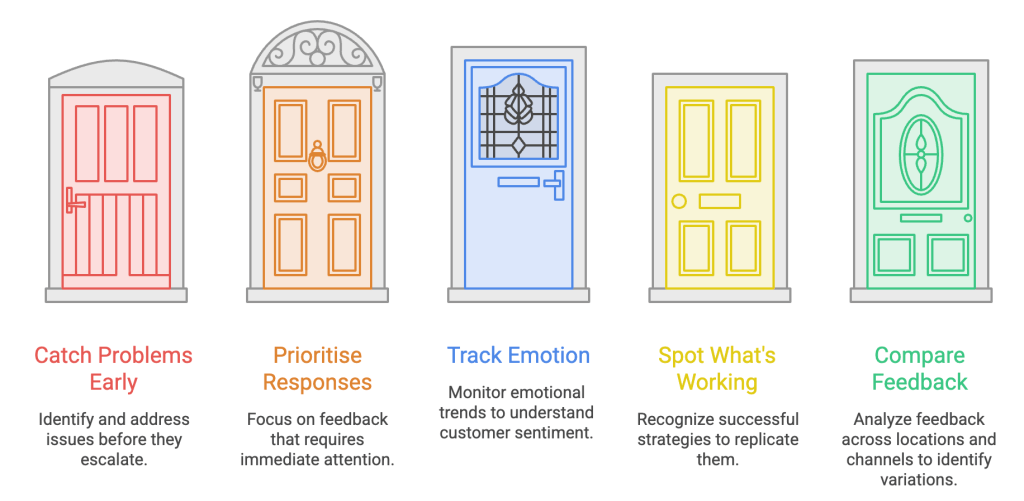
Catch problems while they’re still small:
If sentiment around “wait time” starts dipping even though your star average hasn’t moved yet, that’s your early warning. By the time it shows up in the average, you’ve already lost customers you never found out about.
Prioritise your responses:
Not every review needs the same urgency. A negative review with clearly frustrated language deserves a same-day reply. A neutral one can wait a day without real cost. Sentiment lets you triage instead of responding in whatever order reviews happen to arrive.
Track emotion over time:
Your average rating can stay steady at 4.3 for months while the actual sentiment behind it quietly shifts from delighted to merely satisfied. That’s usually the first sign something is wearing thin, and it shows up in sentiment trends long before it shows up in the star count.
Spot what’s working:
Sentiment analysis isn’t only for finding problems. If a specific dish, product, or staff member keeps coming up with genuinely warm language, that’s worth knowing too. It tells you what to protect, promote, or repeat.
Compare feedback across locations and channels:
If you run more than one outlet or sell across multiple platforms, sentiment lets you see which one is actually delivering the experience you think it is, instead of assuming they’re all performing the same because the overall average looks fine.
How to Start Without a Data Team
You don’t need to build anything from scratch or hire someone to make sense of spreadsheets. Here’s the realistic path:

- Get your feedback into one place: If your reviews are scattered across Google, Instagram comments, and WhatsApp messages, no analysis method fixes that fragmentation for you. Consolidate first.
- Let a tool handle the initial sorting: This is exactly the kind of task a platform like Olly is built for, reading incoming reviews and messages across channels and tagging the sentiment automatically, so you’re not doing this by hand at midnight.
- Read the flagged ones yourself, every time: Let the tool point you to what needs attention. Don’t let it make the final call alone, especially for anything genuinely borderline or sarcastic.
- Check trends weekly: A single bad review is a moment. A shifting trend across two weeks is information you can actually act on.
- Close the loop: Sentiment data that never changes anything about how you run the business isn’t worth collecting. Use what you find to fix something, however small, on a regular basis.
Frequently Asked Questions
Ques. What is customer sentiment analysis?
Ans. It’s the process of analyzing customer feedback, reviews, and messages to identify the emotion behind them, categorising it as positive, negative, or neutral, and sometimes flagging specific emotions like frustration or satisfaction.
Ques. Is sentiment analysis only useful for large businesses?
Ans. No. Small businesses often benefit more, since every piece of feedback carries more weight when overall review volume is lower, and there’s less room to let nuance get lost in an average.
Ques. Can sentiment analysis replace reading reviews myself?
Ans. It shouldn’t. It’s best used to flag what deserves attention first, especially anything ambiguous, sarcastic, or emotionally loaded, so you can read the important ones closely instead of skimming everything equally.
Ques. How accurate is sentiment analysis?
Ans. It’s generally reliable for clearly worded feedback but struggles with sarcasm, very short reviews, and culturally specific phrasing. Treat it as a strong first pass, not a final judgment.
Ques. What’s the easiest way for a small business to start?
Ans. Consolidate feedback from all your channels into one place, use a tool to auto-tag sentiment, and review the flagged feedback and trends on a regular schedule, weekly works well for most small teams.
Where This Leads
The point of sentiment analysis was never to replace the instinct a small business owner already has for reading people. It’s to make sure that instinct gets applied to every piece of feedback, not just the handful you happen to have time to read closely between everything else you’re juggling. The businesses getting real value out of this aren’t the ones with the fanciest dashboards. They’re the ones who read what the flagged feedback is actually telling them and change something small in response, week after week.
That consistency is the whole game. A tool like Olly can do the reading and the sorting for you across every channel your customers actually use. What you do with what it finds is still entirely up to you, and that’s exactly how it should stay.