


Your business’s reputation isn’t something you build once and forget. It’s the sum of every review, every mention, every search result someone sees before they decide to trust you with their money. And in 2026, that reputation lives in more places than ever: Google, Instagram, Reddit, and now, AI chatbots too.
This guide breaks down what reputation management actually means for your business, why it matters more than most owners realize, and how you can build a system for it, whether you run a restaurant, a clinic, a salon, or a SaaS company.
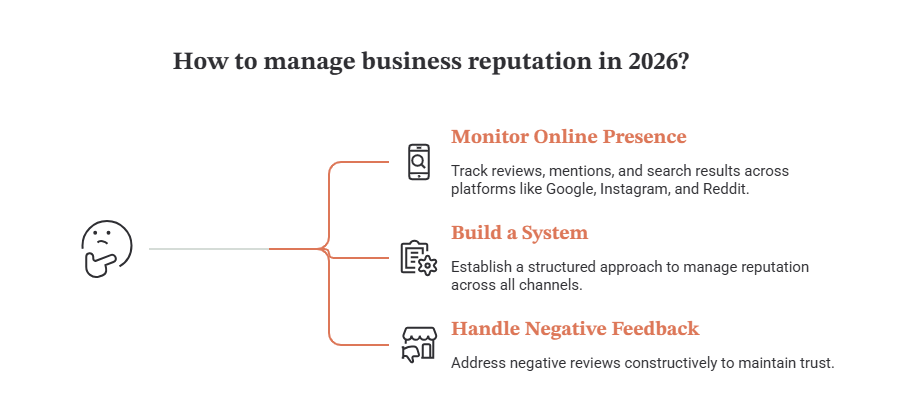
What Is Reputation Management in Business?
Reputation management is the practice of shaping how your business is perceived, online and offline. It combines your reviews, your search presence, your social media activity, and your public relations into one coordinated effort.
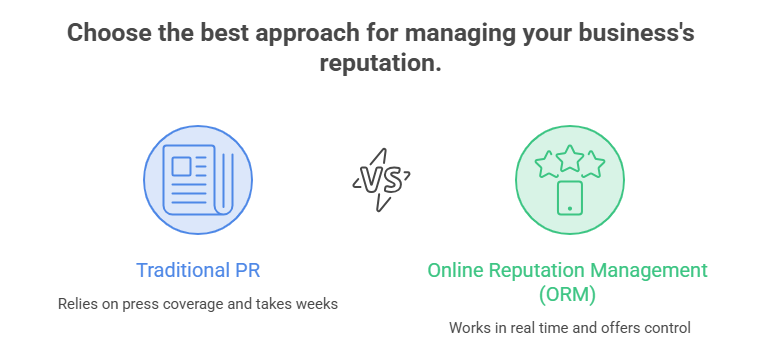
You’ll often hear the term “online reputation management” (ORM) used alongside traditional PR. The difference is speed and control. Traditional PR relies on press coverage and takes weeks to shape a narrative. ORM works in real time. A single Google review can shift a customer’s decision in seconds, so your response to it matters just as much as the review itself.
At its core, reputation management is about making sure the story people find about your business is the one you’d actually want them to read.
Why Reputation Management Matters for Modern Businesses
Trust drives every purchase decision today. Customers check reviews before they buy, job seekers check reviews before they apply, and investors check your digital footprint before they fund you.
A strong reputation brings in customers without you having to convince them of anything. They’ve already made up their mind by the time they land on your page. A weak or damaged reputation does the opposite: it adds friction to every single interaction, even when your product or service is genuinely good.
Reputation also compounds. Every positive review makes the next customer’s decision easier. Every unanswered complaint makes the next one harder. This is why reputation management works best as an ongoing habit rather than a one-time cleanup project.
Online vs. Offline Reputation Management: The Key Differences
Offline reputation is built through word of mouth, community involvement, and the quality of service you deliver in person. It moves slowly and spreads through personal networks.
Online reputation moves fast and spreads publicly. A single review or social post can reach thousands of people who’ve never interacted with your business directly. It’s permanent, searchable, and often the first impression a potential customer forms.
The two feed into each other. Great offline service creates the reviews that build your online reputation, and a strong online reputation brings in the customers who experience your offline service. You need both working together.

Core Components of a Reputation Management Strategy
A complete strategy usually covers these pieces.
Reputation Measurement and Auditing
Understanding where you currently stand across review platforms, search results, and social mentions.
SEO and Search Visibility
Making sure the content that ranks for your brand name is content you control or approve of.
Review Management
Actively monitoring and responding to reviews across Google, industry-specific platforms, and social channels.
Social Listening
Tracking what people say about you even when they don’t tag you directly.
PR and Media Coverage
Building credibility through third-party validation.
Crisis Communication
Having a plan ready before something goes wrong, not after.
Employer Branding
Your reputation as a workplace affects hiring, and job platforms are searchable too.
You don’t need to master all seven at once. Most businesses start with review management, since that’s the piece customers interact with most directly, and build outward from there.
Step-by-Step Process to Build a Reputation Management Strategy
Step 1: Audit Your Current Presence
Search your business name and see what comes up. Check every review platform relevant to your industry.
Step 2: Claim and Complete Your Profiles
Google Business Profile, industry directories, and social platforms should all be claimed, verified, and filled out completely.
Step 3: Monitor Continuously
Set up alerts for new reviews and mentions so nothing slips past you.
Step 4: Respond to Every Review
Good or bad, a response shows you’re paying attention. Silence reads as indifference.
Step 5: Generate Positive Reviews Proactively
Happy customers rarely leave reviews unless you ask. Build the ask into your process.
Step 6: Address Negative Search Results
If something unflattering ranks high, work on building better content to shift the balance.
Step 7: Prepare a Crisis Response Plan
Draft your tone, your key messages, and your escalation process before you need them.
Step 8: Measure and Report Regularly
Track your average rating, review volume, response time, and sentiment trends month over month.
This process works whether you’re managing one location or fifty. The steps stay the same; only the scale changes.

Tools for Reputation Management
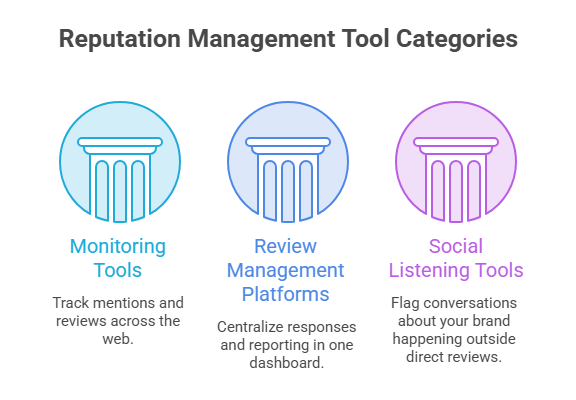
You don’t need to do this manually. Reputation tools generally fall into three categories.
Monitoring Tools
Track mentions and reviews across the web.
Review Management Platforms
Centralize responses and reporting in one dashboard.
Social Listening Tools
Flag conversations about your brand happening outside direct reviews.
This is where a platform like Olly fits in. Olly is an AI reputation manager built for multi-location brands. It reads every review you get across Google, Yelp, TripAdvisor, and over a dozen other platforms, then replies in your voice, trained on your own past responses, so nothing sounds like a bot or a template. It also spots patterns across hundreds of reviews that a person would easily miss, like a recurring complaint at one specific outlet or a staff member consistently earning praise, and ranks what you should fix first. Serious complaints trigger instant alerts so someone on your team owns the issue right away, and a daily recap gives you the full picture of your reputation in under a minute.
Olly doesn’t collect reviews for you. It works with the reviews you’re already getting and turns them into answers, replies, and priorities. And while multi-location F&B brands are a natural fit given how review-heavy that industry is, the same problem shows up anywhere customer decisions hinge on reviews: salons, clinics, retail chains, home services, hospitality. If you’re managing reputation across more than one location, this is the layer that keeps you ahead of it instead of catching up after the fact.
Reputation Management for AI Search and Generative Answers
Here’s the shift most guides haven’t caught up to yet. Customers no longer just Google your business, they ask ChatGPT, AI Overviews, and other AI tools directly. “What’s the best [your category] near me” is now a conversation, not just a search query.
These AI tools pull from reviews, structured data, and how your business is discussed across the web to form their answers. If your review profile is thin or your online mentions are inconsistent, you may simply not show up in these AI-generated recommendations at all.
This means the fundamentals still apply, strong reviews, consistent information, active engagement, but the stakes are higher. You’re no longer just optimizing for a search results page. You’re optimizing for how an AI model summarizes your business to someone who’s never heard of you before.
Common Mistakes Brand Owners Make in Reputation Management
Many businesses treat reputation management as damage control instead of a proactive practice. They only pay attention once a bad review shows up, by which point they’re reacting instead of leading.
Another common mistake is responding defensively to criticism. A defensive reply confirms the reviewer’s frustration to everyone else reading it, not just the original poster.
Businesses also underestimate consistency. A profile that’s updated once and never touched again slowly falls behind competitors who post regularly, respond quickly, and keep their information current.
How to Handle Negative Reviews Without Damaging Trust
Start by acknowledging the issue without getting defensive. Customers reading the response care more about how you handled it than about the original complaint.
Keep your reply short, specific, and solution-focused. Avoid generic templates; a personalized response signals that a real person is paying attention.
Move detailed resolution offline when possible. Public back-and-forth rarely helps either side, and inviting the customer to a direct conversation shows confidence rather than avoidance.
Finally, treat every negative review as information. Patterns across multiple complaints usually point to something worth fixing, not just something worth defending.

FAQs
Ques. What should a beginner focus on first in online reputation management?
Ans. Start with your Google Business Profile and your most active review platform. Getting those two right builds the foundation everything else sits on.
Ques. How do you convince skeptical business owners that reputation management is worth investing in?
Ans. Show them the direct link between review volume, star rating, and conversion rate. Most owners come around once they see the revenue connection in their own numbers.
Ques. What tools or strategies actually work, and what should you avoid?
Ans. Tools that centralize monitoring and response work well. Avoid anything that offers to buy fake reviews or manipulate ratings; platforms penalize this heavily, and it damages trust the moment it’s discovered.
Ques. How do you deal with negative reviews effectively?
Ans. Respond quickly, stay calm, and offer a real path to resolution. Speed and tone matter more than the length of your response.
Ques. How does reputation management combine technology with PR strategies?
Ans. Technology handles monitoring and response at scale, while PR builds the broader narrative through media coverage and public relationships. The two work best when they’re coordinated, not siloed.
Ques. How do you handle reputation management on platforms like Reddit or Quora?
Ans. Monitor these communities the same way you would review sites. Engage genuinely when relevant, and never post as a fake customer; Reddit users are quick to spot and call out inauthentic activity.
Your reputation is one of the few business assets that grows more valuable the more consistently you invest in it. Start small, stay consistent, and let every review, response, and mention work in your favor over time.