Categories
Blogs Insights

The Psychology of Trust: Why Customers Read Google Reviews First

Before a customer visits your website, sees an Instagram post, or looks at your menu, they see your Google Business Profile. In seconds, they use your rating, review count, recent comments, photos, and how you’ve responded to complaints to decide whether your restaurant feels safe, active, and worth the price. That quick scan happens before almost anything else in their decision, which is why understanding the psychology behind it matters more than most restaurant owners realize.

Google Reviews Are the New Restaurant Front Door

Someone searches “best biryani near me” or “family restaurant in Pune.” Google doesn’t just show them your restaurant exists. It shows them what other people thought of it, right there in the same breath as your name and address. That’s the “Google first” behavior almost every diner follows now, whether they’re discovering you for the first time or double-checking a recommendation from a friend.

This changes what actually convinces someone. Your website can say “authentic, family-run, made with love” all day long. That’s a polished brand message, and diners have learned to discount it a little, the same way they discount any ad. A stranger’s honest paragraph about the food, the wait, and whether the kids enjoyed it carries weight your own copy never will. Your Google Business Profile has become the first trust screen a customer passes through, well before they ever reach your actual front door.

Why People Believe Other Customers More Than Brands
customer-reviews-social-proof-human-connection

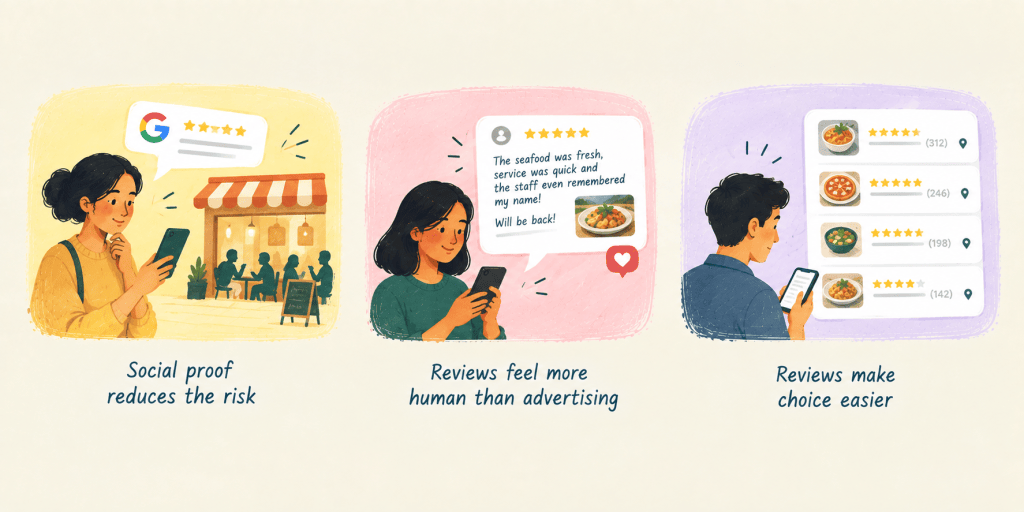
Social proof reduces the risk of choosing wrong

A diner can’t taste the food, check the kitchen, or judge the service before they walk in. So they borrow confidence from people who already did. Repeated mentions of “fresh seafood,” “quick service,” or “great Jain options” do something your menu description never can: they tell a stranger that other people like them already took the risk and it worked out.

Reviews feel more human than advertising

“We serve authentic Italian food” is a claim. A review describing a specific dish, a birthday dinner, a waiter who remembered their name, and what the bill came to is a story. Stories feel harder to fake than claims, even when neither one technically is fake, and that’s exactly why they persuade more.

Choice overload makes reviews a shortcut

When someone’s comparing five similar restaurants nearby, reviews aren’t just a discovery tool. They’re how people eliminate options fast. Ratings and review count let a diner narrow five choices down to two without visiting a single one, which is the real job reviews are doing, whether or not the diner realizes it.

How Diners Actually Read Google Reviews

google-review-reading-diner-behavior-guide

The five-second scan

Most diners don’t read every review. They register the star rating, the review count, and how recent the activity looks, all in the first few seconds. This isn’t a fixed order everyone follows exactly the same way, but it’s a practical pattern: is the number believable, does it look active, and has anyone said anything worrying lately.

What they read after the star rating

Once someone’s actually interested, attention moves to a fairly consistent set of things: the most recent three to five reviews, the newest low-rated one specifically, guest-uploaded photos, phrases that keep repeating across different reviewers, and how the owner responded to anything serious.

The questions hiding inside every review search

Underneath all of this, a diner is really asking a handful of practical questions. Is the food consistently good, not just good once? Is the place clean? Will the wait be reasonable? Does the portion and quality justify the price? Can it handle a family with kids, a dietary restriction, or a special occasion? If they’re ordering in, is delivery actually reliable?

Why consistency matters more than one glowing review

A single five-star review proves almost nothing. Ten reviews independently mentioning slow service prove something real, even if your overall rating still looks fine on paper. In BrightLocal’s 2026 survey, consistent sentiment across multiple reviews turned out to be the single most influential factor in trust, ahead of a high star rating on its own. If a theme keeps showing up, that’s not noise. That’s an operational signal worth investigating.

The Psychology Behind Trust and Distrust
review-factors-similar-experiences-food-safety-platforms

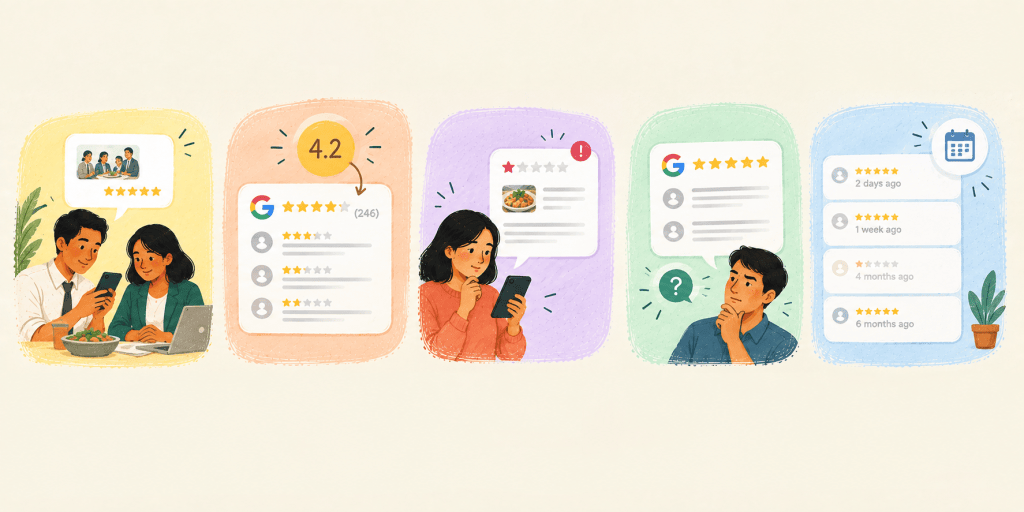
Social proof works because of similarity. A diner planning an office lunch pays more attention to reviews from other office-lunch visits than to a five-star review from someone’s anniversary dinner. People trust experiences that resemble the one they’re about to have.

Anchoring explains why the star rating shapes everything else. The first number a diner sees becomes the lens they read every review through afterward. This is also why chasing a perfect 5.0 isn’t actually the goal. A strong, credible, clearly active profile does more work than a flawless one.

Negativity bias is why one bad review gets disproportionate attention. Diners scan for the worst-case outcome first, especially around food safety, rude service, billing mistakes, long waits, and unreliable delivery, because the cost of a bad choice feels higher than the reward of a good one. Your lowest-rated recent review might genuinely be the most-read piece of copy about your restaurant, more than your menu, more than your Instagram captions.

The “too perfect” effect cuts the other way. An implausibly flawless profile, no complaints, no nuance, nothing but five stars, can quietly raise suspicion instead of confidence. Diners expect a realistic mix. A calm, specific response to a legitimate complaint often builds more trust than an unbroken run of praise ever could, because it shows there’s an actual person managing the place, not a curated illusion of one.

Recency bias means old praise stops carrying weight fast. A restaurant with 500 reviews and nothing new in six months reads as less trustworthy right now than one with 80 reviews and steady recent activity, because diners assume today’s team, menu, and kitchen conditions matter more than last year’s. BrightLocal’s 2026 research found 74% of consumers specifically look for reviews written within the past three months, and 32% look for something from the last two weeks. Stale praise doesn’t protect you from a recent bad week.

Why Google Reviews Matter More Than Your Website

Google has collapsed discovery and evaluation into a single moment. A customer doesn’t discover you, leave, research you elsewhere, and come back. They do both in the same search session, often the same scroll. Your website, Instagram, and delivery-app listings still matter, but they function as the reassurance layer that follows the review decision, not the thing that makes it.

What happens after someone reads your reviews tells the real story. BrightLocal reports that 54% of consumers visit a business’s website after reading positive reviews, and 66% keep researching before actually booking or ordering. Reviews aren’t a vanity reputation metric sitting off to the side. They’re doing three jobs at once: helping people find you, helping them choose you over the restaurant next door, and, when you’re paying attention to the patterns, helping you actually run a better kitchen.

The Trust Signals Diners Look For

A credible number of reviews matters, though there’s no universal threshold. Benchmark against nearby direct competitors instead of chasing a round number. Beyond volume, diners look for recent, specific stories that mention actual dishes, staff members, occasions, cleanliness, speed, and whether the bill matched the experience. Vague five-star praise doesn’t do this work. A prompt that invites honest detail, instead of just asking for five stars, gets you reviews that actually persuade.

Guest-uploaded photos and videos matter too, since they close the gap between your menu photography and what a table actually looks like: portion size, plating, how crowded it gets, parking, the dessert someone ordered. And how you respond says more than most owners assume. In BrightLocal’s survey, 80% of consumers said they’re more likely to use a business that responds to all reviews, while 50% said generic, templated responses actually put them off. A copy-pasted “thank you for your feedback” under a specific complaint reads as indifference, not attentiveness.

If you run more than one location, consistency across every channel, Maps, website, Instagram, delivery apps, reservation platforms, matters just as much. A diner checking a specific outlet doesn’t care about your chain-wide average. They care whether the location near them is any good this month, so local listings and responses need to reflect that specific outlet, not generic corporate language copied across every branch.

The Reply Effect: How a Bad Review Can Build Trust

A good response to a bad review does five things: acknowledges the specific issue, apologizes for where the restaurant genuinely fell short, states what’s being corrected or investigated, moves resolution offline without sounding evasive, and invites the guest back only when that actually makes sense.

What kills trust instead: copy-pasted replies, arguing point by point in public, blaming the customer or a delivery partner, insisting every piece of criticism is fake without any evidence, or apologizing with zero mention of what’s actually changing.

Service-delay example: “We’re sorry the wait didn’t match what we aim for, especially on a night you’d planned for something special. We’re looking into what slowed things down in the kitchen that evening and adjusting our staffing for weekend rushes. We’d love the chance to make it right next time, on us.” This works because it names the specific problem, takes ownership without excuses, states a concrete fix, and closes warmly without sounding scripted.

Food-quality example: “We’re sorry the dish didn’t arrive the way it should have. That’s not the standard we hold ourselves to, and we’ve flagged this with our kitchen team to look into what went wrong. Please reach out directly so we can make this right.” Internally, this kind of complaint deserves more than a public reply. Anything touching food quality or hygiene needs an actual operational review, not just a polite comment.

Can Customers Trust Google Reviews?

Diners are getting sharper at spotting fake reviews: vague language with zero detail, a sudden unnatural burst of five-star ratings in a short window, repetitive phrasing that shows up across unrelated profiles, reviews that don’t match your actual menu or concept, or a profile so flawless it stops looking real.

Buying, gating, or manipulating reviews costs more than it’s worth. Beyond the platform-policy risk, it quietly damages the thing reviews are supposed to give you: honest, usable feedback about how your restaurant is actually running. Google’s own policies require reviews to reflect genuine experiences and explicitly prohibit fake engagement and rating manipulation.

If a review looks fake or malicious, preserve the evidence, check whether you can match it to an actual visit or order, identify the specific policy it breaks, and report it through the proper channel. Respond publicly only when a calm, factual reply genuinely helps other readers understand what happened. And be careful not to treat an ordinary disagreement about food or service as a “fake” review just because it’s inconvenient. Not liking a review isn’t the same as it being untrue.

Turn Reviews Into a Restaurant Trust System

The restaurants that benefit most from reviews treat them as an ongoing system, not a once-a-month check-in.

restaurant-review-trust-system-feedback-tracking

Ask at the right moment: Request feedback after a guest has actually had a good experience, never before, using receipt QR codes, post-visit WhatsApp or SMS, loyalty messages, reservation follow-ups, and delivery feedback flows. Ask everyone honestly, never only your happiest customers, and never ask specifically for five stars.

Route feedback to the team that can fix it: Taste, temperature, and packaging go to the kitchen. Wait times, order accuracy, and staff behavior go to service. Cleanliness, music, parking, and air-conditioning go to operations. Frequently praised dishes and guest photos go to marketing. Feedback that sits unread in an inbox doesn’t improve anything.

Build a weekly outlet-level dashboard: Track review count and average rating, recency, response rate and response time, positive and negative themes, and any serious complaint that needs a root-cause look, broken out by location rather than buried in a chain-wide average.

Measure trust, not just stars: Watch Business Profile views, calls, direction requests, website clicks, bookings, and order conversions. Track what share of reviews mention the experience attributes you actually care about, and whether the same complaint keeps resurfacing after you thought you’d fixed it.

Frequently Asked Questions

Ques. Do people really trust Google Maps and Google reviews? 

Ans. Yes, more than almost any other source, because reviews come from other customers rather than the business itself. That trust isn’t unconditional though. It depends on the reviews looking recent, specific, and consistent, not just numerous.

Ques. Why do customers read Google reviews before visiting a restaurant? 

Ans. Because they can’t taste the food or check the kitchen in advance. Reviews are the closest thing to a preview they can get, and they reduce the risk of wasting money and time on a bad choice.

Ques. How many Google reviews does a restaurant need before customers trust it? 

Ans. There’s no fixed number. What matters more is how your review count compares to nearby direct competitors and whether reviews are coming in consistently, not just piling up once and going quiet.

Ques. Are recent reviews more important than total review count? 

Ans. Generally, yes. A large, old collection of reviews reads as less relevant than a smaller set of recent ones, since diners assume current reviews reflect the team and kitchen running today.

Ques. Can a 4.5-star restaurant look more trustworthy than a 5.0-star one? 

Ans. Often, yes. A flawless rating can read as curated or unrealistic, while a strong but imperfect one, paired with thoughtful responses to the occasional complaint, tends to feel more believable.

Ques. Do restaurant owners need to respond to every Google review? 

Ans. Ideally yes, positive and negative alike. Responding signals that someone is actually paying attention, and generic or absent responses quietly cost you trust with people who are watching, not just the original reviewer.

Ques. Can a professional response to a one-star review change a customer’s mind? 

Ans. It can, especially for future readers rather than the original reviewer. A calm, specific, ownership-taking response often reassures the next hundred people who see it more than it repairs the one relationship it’s addressed to.

Ques. How can diners tell whether a Google review is fake? 

Ans. Vague wording, unnatural bursts of similar reviews, repeated phrasing across different profiles, or content that doesn’t match the actual restaurant are the usual tells.

Ques. Should a restaurant remove negative Google reviews? 

Ans. Only if a review genuinely violates Google’s policies, like fake engagement or content unrelated to a real visit. An honest complaint, even a harsh one, isn’t a policy violation and generally can’t be removed just because you disagree with it.

Ques. Do Google reviews affect local restaurant rankings? 

Ans. Yes. Review volume, rating, and recency all feed into how Google ranks local results, alongside relevance and distance, which makes review activity a genuine SEO factor, not just a reputation one.

Final Thoughts

Reviews aren’t a scoreboard sitting off to the side of your business. They’re the first conversation most customers have about your restaurant, and they’re having it whether you’re part of it or not. The restaurants that treat that conversation seriously, asking for honest feedback, responding like a real person, and routing what they learn back to the kitchen and the floor, end up with more than a good rating. They end up with a restaurant that actually deserves one.

Categories
Blogs Insights

How Small Businesses Can Use Sentiment Analysis to Measure Customer Emotions

Customer sentiment analysis is the practice of reading customer feedback, reviews, and messages to figure out the emotion behind the words, not just whether the rating was good or bad. 

For a small business, it means finally understanding the difference between a customer who left three stars because they were mildly annoyed and one who left three stars because they were furious but too polite to say so. Star ratings tell you what happened. Sentiment tells you how the customer actually felt about it, and that gap matters more than most business owners realise.

Here’s what it actually is, why it matters more for a small business than a large one, and how to start using it without hiring an analytics team you don’t have the budget for.

What Sentiment Analysis Means

Strip away the buzzword, and sentiment analysis is a simple idea: software reads text and sorts it into positive, negative, or neutral, sometimes going a step further to flag specific emotions like frustration, confusion, or delight. It looks at word choice, tone, and context, not just keywords. “The food was fine” and “the food was amazing” both technically praise the food, but they carry very different energy, and a decent sentiment tool picks up on that difference.

Here’s where it gets genuinely useful for a small business. A customer might write, “Service was quick, I’ll give it that, but the staff seemed like they’d rather be anywhere else.” That’s a four-star review on the surface. Read the actual sentence, though, and you’re looking at a customer describing a genuinely bad experience with your team, one that a star count alone would never surface. Sentiment analysis exists to catch exactly that kind of gap between the number and the feeling.

Why This Matters for a Small Business

It’s easy to assume sentiment analysis is a luxury for companies with data teams and dashboards. It’s actually the opposite. 

A large chain gets thousands of reviews a month, enough that a few misread ones barely move the average. A small business might get fifteen reviews in that same month, and every single one of them carries real weight in shaping how the next hundred customers see you.

When you don’t have the volume to average out the noise, you need to understand each piece of feedback properly, not just glance at the star and move on. 

A small business owner reading every review personally can absolutely catch nuance, that’s a real advantage you have. But you’re also busy running the actual business, and nuance is exactly the thing that gets missed when you’re skimming reviews between shifts instead of sitting down and reading them properly. Sentiment analysis isn’t replacing your judgment. 

It’s making sure nothing slips past it just because you didn’t have time to read closely.

What It Catches That Star Ratings Miss

A star rating is a single number standing in for an entire experience, and single numbers flatten a lot of detail. Here’s what tends to disappear in that flattening:

mixed-review-feedback-types

Mixed review: A customer who loved the product but hated the delivery time often lands on three stars, right in the middle, which tells you nothing about which part actually needs fixing.

Polite dissatisfaction: Plenty of customers won’t leave one star even when they’re unhappy. They’ll leave three or four out of habit or courtesy, and bury the real complaint in the text instead. If you only glance at the number, you miss it entirely.

Slow-building patterns: One review mentioning long wait times doesn’t mean anything. Ten reviews across a month, each mentioning it in slightly different words, is a pattern that a simple star average will never show you, because it’s buried across multiple reviews instead of sitting in one obvious place.

This is really the whole case for sentiment analysis in one sentence: it reads what customers actually said, not just the number they clicked.

Where Sentiment Analysis Falls Short

Since this is meant to be useful, not a sales pitch, it’s worth being honest about the limits.

Sarcasm is genuinely hard for any tool to catch. “Wow, waited forty minutes for lukewarm coffee, incredible” reads as enthusiastic if you only look at the words. Short reviews are also tricky. “It was fine” carries almost no signal either way, and no tool can extract emotion from a sentence that barely has any. And cultural or regional phrasing sometimes throws things off too. Understatement, for instance, reads very differently depending on where your customer is from.

None of this means sentiment analysis isn’t worth using. It means treat it as a strong first pass that flags what deserves your attention, not a verdict you accept without reading the actual review yourself. The tool gets you to the right feedback faster. It doesn’t replace reading it.

Practical Ways to Use It

customer-feedback-response-strategies

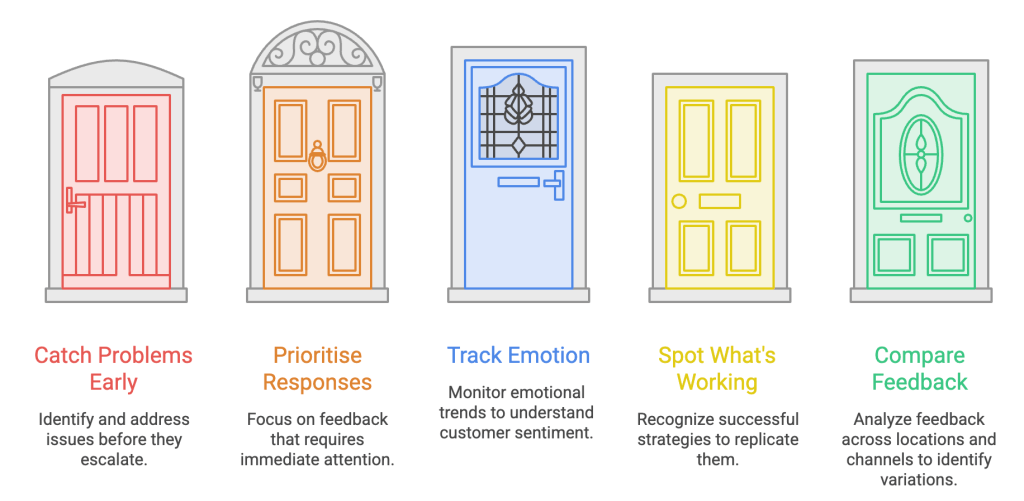
Catch problems while they’re still small: 

If sentiment around “wait time” starts dipping even though your star average hasn’t moved yet, that’s your early warning. By the time it shows up in the average, you’ve already lost customers you never found out about.

Prioritise your responses: 

Not every review needs the same urgency. A negative review with clearly frustrated language deserves a same-day reply. A neutral one can wait a day without real cost. Sentiment lets you triage instead of responding in whatever order reviews happen to arrive.

Track emotion over time: 

Your average rating can stay steady at 4.3 for months while the actual sentiment behind it quietly shifts from delighted to merely satisfied. That’s usually the first sign something is wearing thin, and it shows up in sentiment trends long before it shows up in the star count.

Spot what’s working: 

Sentiment analysis isn’t only for finding problems. If a specific dish, product, or staff member keeps coming up with genuinely warm language, that’s worth knowing too. It tells you what to protect, promote, or repeat.

Compare feedback across locations and channels: 

If you run more than one outlet or sell across multiple platforms, sentiment lets you see which one is actually delivering the experience you think it is, instead of assuming they’re all performing the same because the overall average looks fine.

How to Start Without a Data Team

You don’t need to build anything from scratch or hire someone to make sense of spreadsheets. Here’s the realistic path:

feedback-management-process
  1. Get your feedback into one place: If your reviews are scattered across Google, Instagram comments, and WhatsApp messages, no analysis method fixes that fragmentation for you. Consolidate first.
  2. Let a tool handle the initial sorting: This is exactly the kind of task a platform like Olly is built for, reading incoming reviews and messages across channels and tagging the sentiment automatically, so you’re not doing this by hand at midnight.
  3. Read the flagged ones yourself, every time: Let the tool point you to what needs attention. Don’t let it make the final call alone, especially for anything genuinely borderline or sarcastic.
  4. Check trends weekly: A single bad review is a moment. A shifting trend across two weeks is information you can actually act on.
  5. Close the loop: Sentiment data that never changes anything about how you run the business isn’t worth collecting. Use what you find to fix something, however small, on a regular basis.

Frequently Asked Questions

Ques. What is customer sentiment analysis?

Ans. It’s the process of analyzing customer feedback, reviews, and messages to identify the emotion behind them, categorising it as positive, negative, or neutral, and sometimes flagging specific emotions like frustration or satisfaction.

Ques. Is sentiment analysis only useful for large businesses? 

Ans. No. Small businesses often benefit more, since every piece of feedback carries more weight when overall review volume is lower, and there’s less room to let nuance get lost in an average.

Ques. Can sentiment analysis replace reading reviews myself? 

Ans. It shouldn’t. It’s best used to flag what deserves attention first, especially anything ambiguous, sarcastic, or emotionally loaded, so you can read the important ones closely instead of skimming everything equally.

Ques. How accurate is sentiment analysis? 

Ans. It’s generally reliable for clearly worded feedback but struggles with sarcasm, very short reviews, and culturally specific phrasing. Treat it as a strong first pass, not a final judgment.

Ques. What’s the easiest way for a small business to start? 

Ans. Consolidate feedback from all your channels into one place, use a tool to auto-tag sentiment, and review the flagged feedback and trends on a regular schedule, weekly works well for most small teams.

Where This Leads

The point of sentiment analysis was never to replace the instinct a small business owner already has for reading people. It’s to make sure that instinct gets applied to every piece of feedback, not just the handful you happen to have time to read closely between everything else you’re juggling. The businesses getting real value out of this aren’t the ones with the fanciest dashboards. They’re the ones who read what the flagged feedback is actually telling them and change something small in response, week after week.

That consistency is the whole game. A tool like Olly can do the reading and the sorting for you across every channel your customers actually use. What you do with what it finds is still entirely up to you, and that’s exactly how it should stay.

Categories
Blogs Insights

How Online Reviews Influence Local SEO (And What To Actually Do About It)

Online reviews influence local SEO by strengthening prominence and trust signals, but they work alongside relevance, proximity, and accurate business information, not instead of them. 

A business with hundreds of glowing reviews and an incomplete Google Business Profile will still lose to a competitor with a leaner review count and a fully accurate, well-optimised listing. Reviews matter. They just aren’t the whole story, and treating them like a magic ranking lever is where most businesses waste effort.

This guide breaks down exactly how reviews affect local search, where to focus first, and how to build a review process that helps your rankings and your customers at the same time.

Local SEO in 30 Seconds

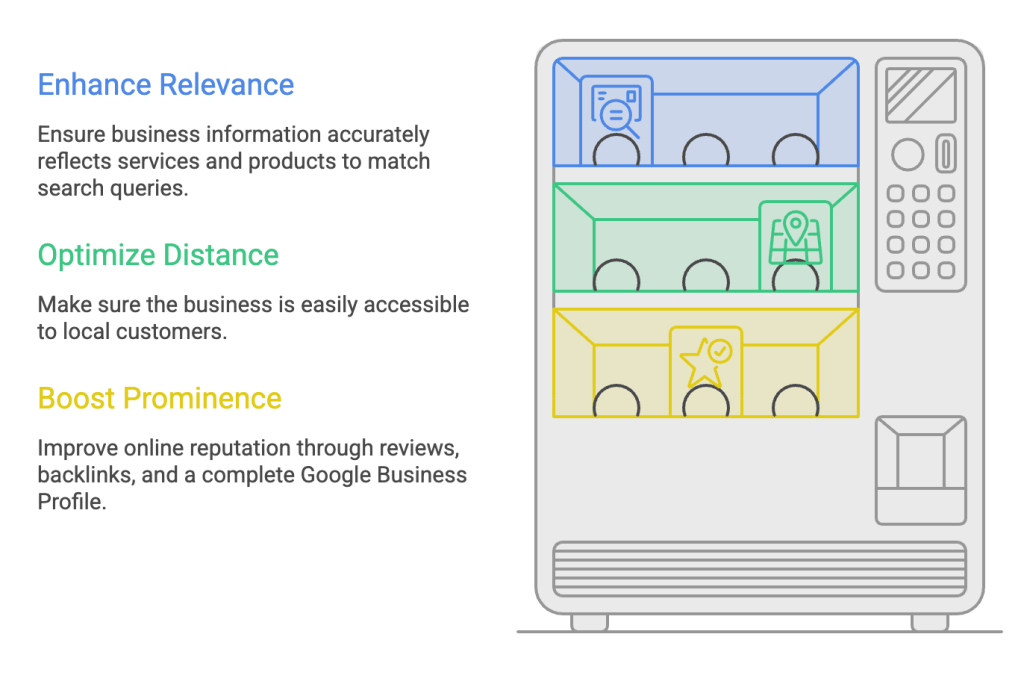
Local search results, the Local Pack, Google Maps listings, and “near me” searches, are shaped by three core factors: relevance to the search, distance from the searcher, and prominence, which is essentially how well-known and credible Google considers a business to be. 

local-seo-ranking-factors-relevance-distance-prominence

Reviews sit inside prominence, alongside things like backlinks, citations, and how complete your Google Business Profile is. A strong review profile can lift prominence. It can’t fix a business listed under the wrong category or a website that doesn’t mention what it actually offers.

How Reviews Actually Affect Your Local Rankings

customer-reviews-impact-on-local-search-rankings

They Signal That a Business Is Active and Credible

A steady stream of reviews tells Google, and customers, that a business is currently operating and engaging with people. This is less about any single review and more about the overall pattern: how many you have, how recently they arrived, and how consistently they keep coming in.

Quantity and Recency Matter More Than Any Single Rating

Review count, recency, and velocity (how consistently new reviews arrive over time) tend to matter more for visibility than chasing a perfect five-star average. A business with 150 reviews averaging 4.6, with new ones arriving every week, generally reads as more credible and active than one with 20 reviews at a perfect 5.0 that stopped coming in eight months ago. Avoid treating any single percentage or formula you read online as gospel here. Ranking studies use different datasets and methodologies, and what matters most is how your profile compares to the businesses actually ranking above you.

Diversify Beyond a Single Platform

Google Business Profile is the priority for Google’s own local results, but a reputation built entirely on one platform is fragile. Industry-specific platforms, social media mentions, and third-party review sites all add up to a broader footprint, and customers frequently check more than one source before deciding. Which platforms matter most depends entirely on where your specific customers already look, which varies by industry.

Review Text Adds Context, Not Keywords

When customers naturally mention what they bought, the service they used, or the location they visited, that text reinforces relevance for anyone reading it, prospective customers and Google alike. This should never be engineered. Asking customers to use specific words or phrases in their reviews violates most platform policies and reads as inauthentic anyway. Let people describe their experience in their own words.

Responding Shows You’re Paying Attention

Replying to reviews demonstrates that a business is active and engaged, which supports the same prominence signals as review volume. More importantly, a good response can clarify a policy, correct a misunderstanding, or resolve a concern for every future reader, not just the person who left the review.

Reviews Win the Click, Even When They Don’t Win the Rank

Ranking well gets you into the results. Reviews are often what gets you the click once you’re there. Picture two similarly ranked businesses in the same category and area. One has a 4.7 rating built from 200 recent reviews. The other has a 3.9 rating from reviews that stopped six months ago. Most searchers pick the first one, regardless of which one technically ranks a spot higher.

Detailed reviews also do a job your own marketing copy can’t: they answer the specific questions a prospective customer has before they ever contact you. Depending on the business, that might mean quality, pricing, wait times, cleanliness, parking, delivery speed, or whether a specific need is accommodated. That reassurance shows up as more calls, more direction requests, more bookings, and more walk-ins, even when the ranking position itself hasn’t moved.

Where to Focus: Review Platforms That Matter

best-review-platforms-for-local-businesses
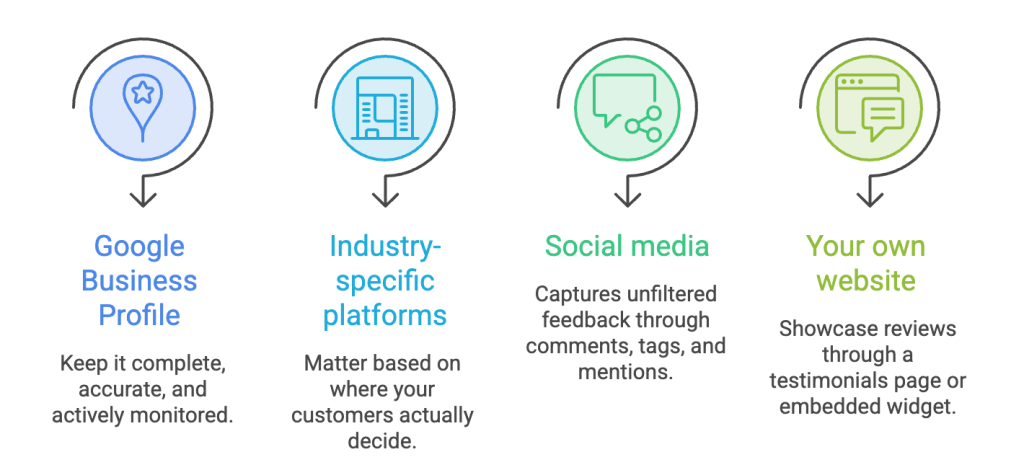
  • Google Business Profile is non-negotiable. Keep it complete, accurate, and actively monitored.
  • Industry-specific platforms matter based on where your customers actually decide. That might be TripAdvisor and Zomato for a restaurant, or an industry directory and Facebook recommendations for a service business.
  • Social media captures unfiltered feedback through comments, tags, and mentions, often before it ever becomes a formal review.
  • Your own website should showcase reviews through a testimonials page or embedded widget, mainly to build trust and support conversions rather than as a direct ranking shortcut.

Don’t assume embedding reviews on your site automatically improves your Google rankings. It doesn’t, directly. What it does is give visitors a reason to trust you once they’ve already landed there.

Auditing Your Current Review Profile

Before fixing anything, get a clear picture of where you stand. Track this for your own business and your top three to five competitors:

  • Total review count and average rating, per platform
  • Date of the most recent review, and reviews received in the last 30, 60, and 90 days
  • Response rate and average response time
  • Recurring themes or complaints
  • Platform presence gaps, places competitors show up that you don’t

This audit alone usually surfaces the biggest opportunity: a platform where competitors have real traction, and you have none, or a pile of unanswered reviews sitting untouched for months.

Getting More Authentic Reviews

strategies-for-getting-more-authentic-customer-reviews

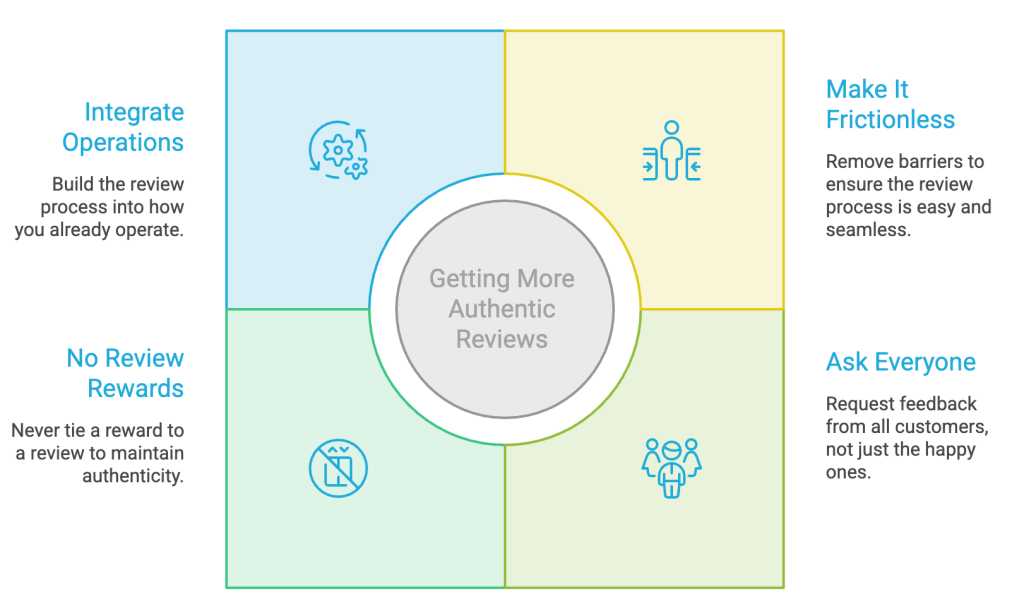
Make It Frictionless

A direct review link, a QR code on a receipt or invoice, or a request sent through a post-purchase WhatsApp or email message all lower the effort it takes a customer to leave feedback. Ask soon after a genuine interaction, and keep the process mobile-friendly from start to finish.

Ask Everyone, Not Just the Happy Ones

Approach review requests consistently, not selectively. Only asking customers you already know are satisfied is called review gating, and most platforms explicitly prohibit it. It also quietly skews your data, which defeats the purpose of collecting it at all.

Never Tie a Reward to a Review

Don’t offer discounts for reviews, ask customers to change a rating, or pressure anyone on-site. A simple, honest request works better anyway: “Thank you for choosing us. If you have a moment, we’d appreciate your honest feedback on Google. It helps other customers know what to expect and helps us improve.”

Build It Into How You Already Operate

Post-purchase messages, reservation confirmations, delivery completion notes, and support follow-ups are all natural moments to ask, without adding a separate task to anyone’s plate. This is where a tool like Olly fits in. It’s not built for one type of business. Whether you run a restaurant, a salon, a clinic, or a retail store, Olly pulls every review across platforms into one dashboard, flags negative or unusual feedback in real time, and helps you respond consistently, so your review picture stops living across five separate logins.

Responding to Reviews the Right Way

For positive reviews: thank the customer, reference something specific from what they said, and invite them back. Genuine beats generic every time: “Thank you for the kind words about our service and the quick turnaround. We’re glad it worked out and hope to see you again soon.”

For negative reviews: acknowledge the experience, apologise where appropriate, and avoid arguing in public. Address the specific concern, explain what happens next, and move the details to a private channel: “We’re sorry this didn’t meet expectations. This isn’t the standard we aim for. Please reach out at [contact] with your details so we can look into it directly.”

For older, unanswered reviews: prioritise recent and unresolved ones first, but circle back to older reviews that raised a recurring issue or never got a reply. Don’t expect a late response to move your rankings on its own. Do it because it’s still useful to the person who took the time to write it.

Handling Fake and Policy-Violating Reviews

Not every negative review is fake, and treating genuine criticism as an attack rarely ends well. Reserve reporting for actual policy violations: fabricated experiences, paid or incentivised reviews, competitor sabotage, spam, or reviews containing personal information or harassment. Google can act on genuine violations, but legitimate negative reviews generally can’t be removed, only responded to.

Never buy reviews, offer incentives tied to them, or ask staff to post them. If you ever face review extortion, someone threatening a bad review unless you pay up, save every message, don’t pay, report it through the platform, and document the incident.

Common Mistakes Worth Avoiding

common-customer-review-management-mistakes-to-avoid
  • Chasing the rating and ignoring volume. A 5.0 from six reviews is less convincing than a 4.6 from two hundred.
  • Sudden review bursts. A spike that looks unnatural often reads that way to both customers and platforms.
  • Copy-pasting the same response everywhere. It’s the fastest way to make genuine engagement look automated.
  • Assuming reviews fix everything. They can’t substitute for accurate business information, a solid website, or an actual good experience.

Frequently Asked Questions

Ques. Do online reviews directly affect local SEO rankings? 

Ans. Reviews are associated with local visibility and prominence, but rankings also depend on relevance, proximity, and overall profile quality. Treat reviews as one signal among several, not a standalone lever.

Ques. Is review quantity or rating more important? 

Ans. Both matter, but consistent, recent volume tends to build more credibility than a small number of perfect ratings. Benchmark against competitors ranking for the same searches rather than chasing an arbitrary number.

Ques. Does responding to reviews actually help SEO? 

Ans. It supports trust, engagement, and customer service, all of which feed into prominence. It’s not a guaranteed way to jump rankings on its own, but it consistently helps conversions and retention.

Ques. Will embedding reviews on my website improve my rankings? 

Ans. Not directly. It’s primarily a trust and conversion tool for visitors who’ve already found you, not a ranking shortcut.

Ques. Can I get a negative review removed? 

Ans. Only if it violates platform policy. Legitimate criticism, even when it stings, generally has to be handled through a response and real service recovery, not removal.

Where This Goes Next

Reviews aren’t a checkbox you tick once and forget. They’re an ongoing signal of whether a business is actually delivering, and both customers and search engines are reading that signal constantly. The businesses that treat review collection and response as a routine part of operations, not a quarterly scramble, are the ones that keep compounding trust while everyone else resets to zero every few months.

Start with the audit. Fix the gaps it surfaces. Then build the ask into moments that are already happening, a checkout, a delivery, a support ticket, so it stops depending on anyone remembering to do it manually. Tools like Olly exist for exactly that part, pulling every platform into one place so the only thing left for you to focus on is actually earning the good reviews in the first place.

Categories
Blogs Insights

Salon Reputation Management: The Ultimate Guide

Someone is scrolling through Google, trying to find a salon nearby. Two options pop up. One has hundreds of glowing reviews and kind replies from the owner. The other has a handful of reviews from two years ago and not a single reply in sight.

Which one gets the booking? Easy answer.

salon-google-reviews-comparison-booking-decision

That right there is why salon reputation management matters so much. Long before a client sits in your chair, they’ve already formed an opinion about your salon. And that opinion is built almost entirely on what other people are saying online.

The good news? Reputation management isn’t complicated or expensive. It just needs a little consistency. This guide breaks down everything salon owners need to know, from why reviews matter, to handling the tough ones, to turning happy clients into your best marketing tool.

Why Salon Reputation Management Is a Big Deal in 2026

Word of mouth used to happen over coffee or at the school gate. Now it happens on Google, Instagram, and Yelp, and it happens fast.

Here’s a stat you should know: 97 percent of people read online reviews before booking a salon appointment, according to BrightLocal’s 2026 Local Consumer Review Survey. That’s basically everyone. And 94 percent of potential clients will skip right past a salon with a rating under 4 stars, no matter how good the actual haircuts are, according to HJI Research.

There’s also a trust factor at play.

Close to 8 out of 10 salon clients trust online reviews just as much as a recommendation from a friend, per ZipDo’s Customer Experience Report. Reviews have quietly replaced word of mouth, and they now do it at a much bigger scale. One bad review can undo years of loyal, happy clients if it’s left sitting there unanswered.

Volume matters too.

Nearly half of all customers won’t even consider a business with fewer than 20 reviews, per BrightLocal. So if a salon is doing beautiful work but only has 8 reviews, most people scrolling past will assume it’s new, untested, or simply not worth the risk. Getting to 20, then 50, then 100 reviews isn’t about vanity. It’s about looking like the safe, trusted choice.

Why Salons Feel This More Than Most Businesses

Haircuts and color are personal. A bad haircut doesn’t just cost money, it affects how someone feels about themselves for weeks. That emotional weight is exactly why people research salons so carefully before booking, and why they’re more likely to leave detailed, honest reviews after their visit.

Clients also don’t just read the words in a review. They study the photos. Before and after shots carry serious weight for a beauty business, often more than the star rating itself.

And here’s something a lot of salon owners don’t realize: Google’s local search results, the map with the top three salons that show up for “salon near me,” rely heavily on review count, recency, and how often the owner replies. Salons with 50 or more reviews show up in that local pack roughly twice as often as salons with fewer, according to Rework Beauty Center’s 2026 growth data. That top three spot gets the lion’s share of the clicks, so reviews aren’t just nice to have anymore, they’re part of the local SEO engine.

The Real Reasons Salons Get Bad Reviews

Before jumping into fixes, it helps to know where most of the trouble actually starts.

common-salon-customer-complaints-and-review-challenges

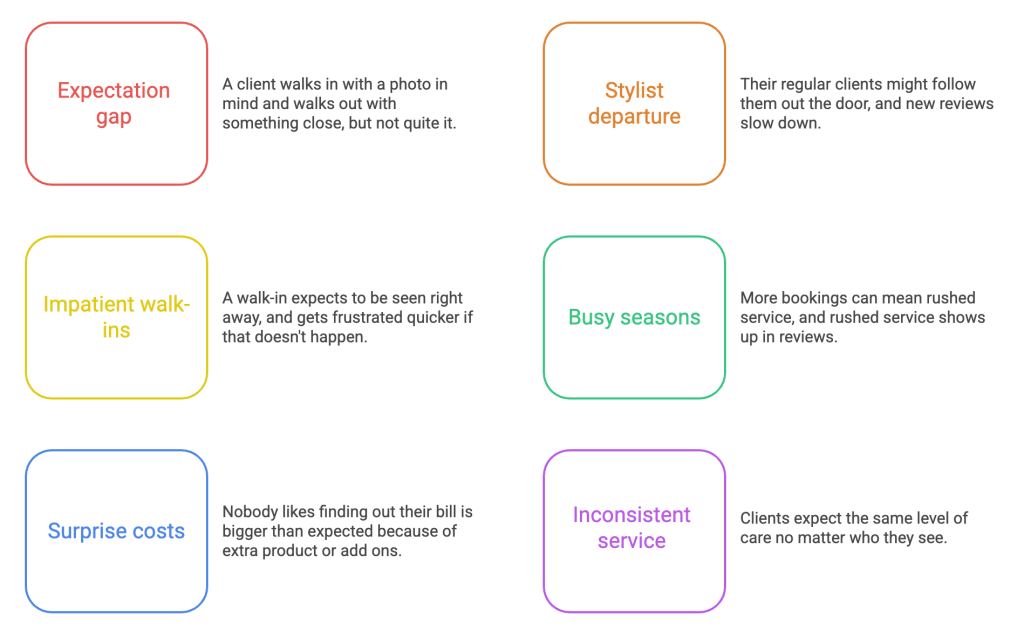
The gap between expectation and result: A client walks in with a photo in mind and walks out with something close, but not quite it. This mismatch is behind most negative reviews, and it’s almost always fixable with a quick chat mid appointment.

A favorite stylist leaves: Their regular clients might follow them out the door, and new reviews slow down. The fix is building a review culture around the salon as a whole, not just individual stylists.

Walk-ins get impatient faster: Someone who booked an appointment expects a wait sometimes. A walk-in expects to be seen right away, and gets frustrated quicker if that doesn’t happen.

Busy seasons stretch everyone thin: Prom season, wedding season, festive season. More bookings can mean rushed service, and rushed service shows up in reviews.

Surprise costs: Nobody likes finding out their bill is bigger than expected because of extra product or add ons that were never mentioned upfront.

Inconsistent service between stylists: Clients expect the same level of care no matter who they see. When that varies a lot, it shows up in the reviews too.

Knowing these patterns means salon owners can get ahead of them, instead of just reacting after the damage is done.

Simple Ways to Build a Stronger Salon Reputation

None of this needs a marketing degree. Here’s what actually works.

Make Asking for Reviews Part of the Routine

The best time to ask for a review is right after the service, while the client is still admiring their new look in the mirror. Waiting two days means the moment has passed and so has the motivation.

A few easy ways to make asking effortless:

  • A QR code taped near the mirror or at the reception counter
  • A quick WhatsApp or text message with a direct link to the review page
  • A short, friendly nudge from the stylist before the client leaves

The data backs this up too. Around 85 percent of clients leave a review after a great experience, but only 30 percent bother after a bad one, according to ZipDo. That means most reviews waiting to be collected are positive ones, they just need a gentle ask to actually get written.

Reply to Every Single Review

Every one. The five star ones and the one star ones.

Responding shows care, and clients notice. Harvard Business Review data, cited by Rework in 2026, found that replying to reviews (good or bad) can lift booking conversion by around 18 percent. On the flip side, roughly 65 percent of salons never bother replying to negative feedback at all, according to a 2026 Reputation Management Report, which means simply showing up and responding puts a salon ahead of most competitors without any extra effort.

Speed matters here too. Top rated salons reply to reviews in about 1.2 days on average, compared to 8.7 days for poorly rated salons, based on a 2026 review response time benchmark. Fast replies and good ratings tend to go hand in hand.

A quick reply to a happy review can be as simple as:

“Thank you so much! So glad you loved your new color, can’t wait to see you again soon.”

Check In Mid Service

A lot of negative reviews can be avoided entirely with one simple habit: checking in while the service is happening, not just at the end. During color processing time is the perfect window to ask “how does this feel so far” or “is this the shade you had in mind.” Catching a concern early means fixing it before the client ever leaves the chair, instead of reading about it online later.

Talk Pricing Before Starting

Nothing sours an experience faster than an unexpected bill. Being upfront about the cost of extra product, long hair charges, or any add ons before starting the service builds trust and avoids one of the most common complaints salons deal with.

Keep Listings Fresh

Outdated hours, an old phone number, or a service menu that hasn’t been touched in a year frustrates clients before they even walk in. A regular check of Google Business Profile, Facebook, and any booking platforms keeps the information accurate and the salon looking active and trustworthy.

Use a Tool to Keep Track of Everything

Trying to manually check Google, Facebook, Yelp, and booking apps every single day gets old fast, especially for a busy salon owner juggling clients, staff, and supplies.

This is where a tool like Olly comes in handy. It quietly keeps watch over all those platforms in one place, flags anything urgent that needs a fast reply, and even helps draft responses that sound like the salon’s own voice. Instead of hopping between five different apps hoping nothing slipped through the cracks, everything lands in one simple dashboard.

Where Clients Actually Look Before Booking

It helps to know exactly where people are checking before they decide to book, so effort goes into the right places.

Google Business Profile comes first, by a wide margin. Somewhere around 70 percent of local salon discovery happens right here, and it’s also the biggest factor in whether a salon shows up on the map when someone searches “salon near me.” Photos, hours, and reviews all live here, and keeping it fresh pays off more than almost anything else on this list.

Instagram and Facebook come next. Around 78 percent of salon clients say they discover new salons through Instagram or Facebook, according to Marketing LTB’s 2026 salon marketing data. A lot of clients spot a salon through a friend’s tagged post or a reel showing a transformation, then jump straight to Google to check the reviews before actually booking. Social media brings people in, reviews close the deal.

Yelp still holds weight, especially for salons in busier cities or upscale markets, where people compare a few options side by side before choosing.

Booking platforms like Treatwell, Booksy, or StyleSeat matter too, since a lot of clients are actively browsing these apps specifically to find and book a service, not just researching casually.

The takeaway here is simple. Trying to be everywhere at once isn’t necessary. Getting Google Business Profile in great shape first, then layering in the others, covers most of what actually influences a booking decision.

How to Handle a Negative Review Without Losing Sleep

Every salon gets one eventually. What matters is the response, not the review itself.

Here’s a simple framework that works almost every time.

best-practices-for-responding-to-negative-salon-reviews

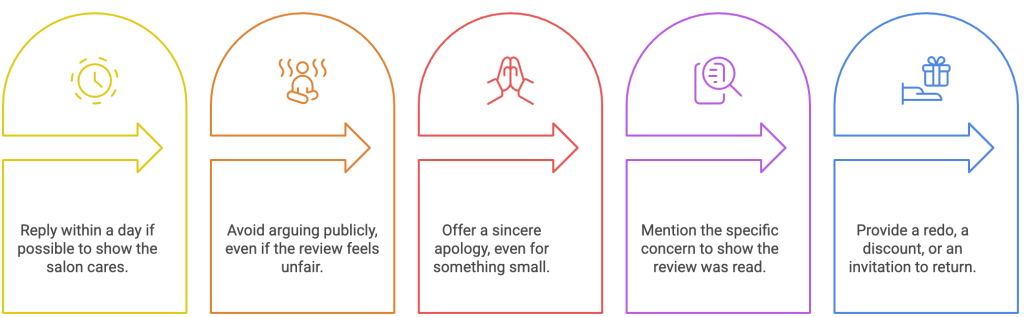
Reply quickly: Within a day if possible. Speed shows the salon cares.

Stay calm: Arguing publicly never ends well, even if the review feels unfair.

Apologize (genuinely): Even for something small, a sincere apology goes a long way.

Name the actual issue: A generic “sorry for your experience” feels hollow. Mentioning the specific concern shows the review was actually read.

Offer a fix: A complimentary redo, a discount on the next visit, or an invitation to come back and make it right.

Move it offline: Ask them to call or message directly so the details can be sorted privately.

A simple example that covers most of this:

“So sorry to hear the color didn’t turn out the way you wanted. That’s never the experience we want anyone to have. Would love the chance to fix it for you, free of charge. Please give us a call whenever works for you.”

Something worth remembering: ZipDo found that 45 percent of negative reviews get resolved by the salon within 48 hours, and about 60 percent of those clients end up returning. A bad review isn’t the end of the relationship. It’s often just the start of a better one, if it’s handled right.

Turning Happy Clients Into Free Marketing

Reviews aren’t just for damage control. The good ones are pure marketing gold, and most salons barely use them.

A few easy ways to put great reviews to work:

  • Feature the best ones right on the salon website homepage
  • Share before and after photos alongside the client’s kind words on Instagram
  • Add a favorite quote to email newsletters or WhatsApp broadcasts
  • Ask clients if they’d be comfortable recording a short video testimonial

Reviews with specific details, like a mention of a balayage or a bridal look, tend to convert better than generic ones. They also help with search since people often type in exactly what they’re looking for, like “balayage salon near me.” When a review naturally uses that same language, it helps the salon show up for those searches too.

A Simple Monthly Reputation Checklist

For anyone who wants a no fuss routine to follow, here’s a simple one.

Every week: Reply to any new reviews. Ask a few happy clients for feedback.

Every month: Check overall rating trends. Look for any repeated complaints across reviews. Update photos and service listings if anything’s changed.

Ongoing: Keep training staff on service consistency and how to gently ask for reviews without sounding pushy.

That’s really it. No fancy spreadsheets needed, just a habit that gets built into the regular rhythm of running the salon.

Frequently Asked Questions

Ques. How many reviews does a salon actually need?

Ans. Somewhere around 30 to 50 reviews with a rating above 4.3 stars is usually enough to build trust with new clients. After that, staying consistent with a few new reviews each month matters more than chasing a big number.

Ques. Should discounts be offered in exchange for reviews?

Ans. No. Google doesn’t allow reviews to be tied to any kind of discount or incentive. A better move is rewarding loyalty in general, through points or small giveaways, without making it a condition for leaving a review.

Ques. What’s the best time to ask for a review?

Ans. Right after the appointment, ideally within the first couple of hours while the client is still feeling good about the result.

Ques. Should every single review get a reply?

Ans. Yes. Even a short, warm thank you for a five star review shows the salon is paying attention and values its clients.

Ques. What if a review feels completely unfair or fake?

Ans. Stay professional in the public reply, and offer to sort things out directly. If it genuinely looks fake, most platforms allow it to be flagged for review.

Ques. How can bad reviews be prevented in the first place?

Ans. Mid service check ins, clear pricing conversations, and consistent training across stylists handle most of the common complaints before they ever turn into a review.

Ques. Does it matter which platform the reviews are on?

Ans. Google carries the most weight since it directly affects local search rankings, but Instagram, Facebook, and booking apps all add to the overall picture a potential client forms before choosing a salon.

Ques. Is it worth using a tool instead of tracking reviews manually?

Ans. For a salon juggling multiple platforms and a busy schedule, yes. Manually checking five different apps every day is a lot to keep up with on top of running the floor.

Ques. What exactly does Olly do for a salon’s reputation?

Ans. Olly keeps watch over reviews across Google, Yelp, Facebook, and other platforms from one place, so nothing goes unnoticed. It flags anything urgent, like a critical review, right away, and can draft replies in the salon’s own tone so responding stays quick and consistent instead of becoming another task piling up at the end of the day.

The Bottom Line

A salon’s reputation isn’t built overnight, and it isn’t left to chance either. It’s shaped by every single appointment, every reply, and every small moment where a client feels heard.

The salons that grow fastest aren’t always the ones with the fanciest interiors. They’re the ones that consistently ask for feedback, reply with warmth, and fix problems quickly when something goes wrong.

Salon reputation management doesn’t need to eat up hours every week. A little consistency, paired with a tool like Olly to keep an eye on every platform in one place, makes the whole thing feel a lot less overwhelming and a lot more automatic.

Great work deserves to be seen. Managing the reputation around it just makes sure that happens.